Skip to content
Tagged COVID-19 Biotechnology SARS-CoV-2 Life Science cancer CORONAVIRUS pandemic
BioXone

BioXone

rethinking future

October 7, 2026
  • About
  • BiotechTodayNews
    • IndiaWeekly Biotech News of India
    • WorldWeekly Biotech News of The World
  • DNA-TalesArticles
    • BiotechnopediaInteresting articles written by BioXone members and associates.
    • Scientists’ CornerArticles from the pioneers of Biotechnology.
    • Cellular CommunicationInterview of greatest researchers’ in the field.
  • Myth-LysisFact Check
  • Signalling PathwayCareer related updates
    • ExaminationsExamination related articles.
    • Job and InternshipJobs and Internship related articles.
  • Courses
  • Contact

Most Viewed This Week

July 13, 2026July 13, 2026

Why Do We Age? The Biology Of Ageing Explained

1
October 17, 2023October 16, 2023

The Corrosion Prediction from the Corrosion Product Performance

2
October 1, 2023September 30, 2023

Nitrogen Resilience in Waterlogged Soybean plants

3
September 28, 2023September 28, 2023

Cell Senescence in Type II Diabetes: Therapeutic Potential

4
September 26, 2023September 25, 2023

Transgene-Free Canker-Resistant Citrus sinensis with Cas12/RNP

5
September 25, 2023September 25, 2023

AI Literacy in Early Childhood Education: Challenges and Opportunities

6

Search Field

Subscribe Now

  • Home
  • DNA-Tales
  • Study on the interaction of Zinc(II) Complexes with Schiff Bases: A case study using Cetyltrimethyl Ammonium Bromide

Tata Innovation Fellowship 2020-21 – Life Sciences & Biotechnology

CDFD COVID-19 Scientist Recruitment

Study on the interaction of Zinc(II) Complexes with Schiff Bases: A case study using Cetyltrimethyl  Ammonium Bromide
  • DNA-Tales
  • Scientists' Corner

Study on the interaction of Zinc(II) Complexes with Schiff Bases: A case study using Cetyltrimethyl Ammonium Bromide

bioxone October 7, 2020October 6, 2020

Sristi Raj Rai 1 , Anwita Sarkar 1 , Akshaya Pandey 1 , Sanchari Dasgupta 2, Ishani Majumder 2 , Debasis Das2, Debosreeta Bose 3* , and  Madhumita Mukhopadhyay 3* 

1 Amity Institute of Biotechnology,  Amity University Kolkata, Rajarhat Newtown, Kolkata 700135.

2 Department of Chemistry, University of Calcutta, 92, A. P. C. Road, Kolkata 700 009, India

3 Department of Chemistry, Amity University Kolkata, Rajarhat Newtown, Kolkata 700135

–

Photometric studies of fluorophores have gained tremendous attention from the present-day chemists and biologists. Microenvironments around the reactants greatly influence the chemical reactions carried out both in ex-situ and in-vivo biological media. Modern-day research is attracted towards the understanding of underlying chemistry and biology associated with these fluorophore molecules in organized biomimicking/microheterogenous media. Micelles belonging to the microenvironment of surfactant molecules are considered to be the simplest and thermodynamically favoured self-assembled system. Studies on binding interaction of fluorophore molecules with micelles have potential applications of drug delivery, synthesis of functional materials, nano-medicine development, sensors etc. Metal-Organic Frameworks (MOFs) are found as the functional materials in the recent works on sensors, solid-state devices, mesoporous materials.

The host-guest chemistry of Metal-Organic Frameworks (MOFs) has been found to function as an excellent explosive sensor because of its porosity and high surface area. Literature reviews show that fluorimetric method of detection is a very simple technique and highly sensitive, however, the preparation of MOFs is time-consuming, costly, and sometimes requires drastic conditions. Schiff base complexes bear large applications in the field of catalysis, sensors, etc. Under such a scenario, Zn (II) based Schiff base complexes are rarely reported which can be employed for detection of explosives through fluorescence studies. 
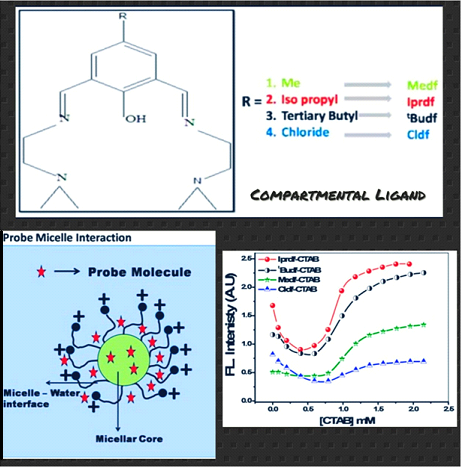
Dasgupta et al. have synthesized and characterized a library of Zn (II) Schiff base complexes wherein methyl, isopropyl, tert-butyl, and Cl are placed in the para position of phenol of four distinct compounds respectively. These complexes of Zinc (II) Schiff bases have been synthesized and characterized to apply them as a nitroaromatic detector by utilizing their fluorescent behaviour. 

The fluorescent behaviour of these nitroaromatic sensor Schiff bases in Cetyl trimethyl ammonium bromide (CTAB) provides us an eye to decipher these zinc (II) complexes of Schiff bases in biomembranes. Entrapping of such potent molecules with different biomimetic environments attracts interest in exploring the potential usefulness of its fluorescence properties for the understanding of its interactions with relevant biological media.

A detailed photophysical study of zinc (II) Schiff bases 2,6-bis((E)-((2-(dimethylamino) ethyl)imino)methyl)-4-R-phenol, where R= methyl/ isopropyl/ tertiary butyl/ chloro for HL1 – HL4 have been done by utilizing CTAB as the biomimicking membrane. Steady-state fluorescence absorption and emission studies have been applied to investigate the due course of the deciphering. Preliminary studies show the fluorescent intensity of all the four complexes first decreases then increases until it reaches a saturation value. The binding constant values reveal that the Schiff bases bind to the micellar compartment. Upon binding with the surfactant molecule, CTAB the photophysical behaviour of the complexes is modified as compared to the situation in aqueous solution. The substituents of the compartmental ligand significantly influence the binding of the Schiff base complexes with the micellar CTAB environment.

In conclusion, these results will add knowledge about the potential applications and dynamical behaviour of these Schiff bases in the field of colloid and interface science.

Also read: Molecules for Life- Thioredoxin System

This article is based on the research paper published in Macromolecular Synposia

Rai Sristi Raj,  Sarkar Anwita,  Pandey  Akshaya,  Dasgupta  Sanchari,  Majumder Ishani,  Das Debasis,  Bose  Debosreeta,  Mukhopadhyay Madhumita  .Photometric Study of the Interaction of Zinc (II) Complexes of Schiff Bases with Cetyltrimethyl Ammonium Bromide(2019), Macromolecular Symposia, 388, pp. 1900030(1-7), (Wiley-VCH Verlag GmbH & Co. KGaA, Weinheim)  https://doi.org/10.1002/masy.20190003

  • Why Do We Age? The Biology Of Ageing Explained
  • The Corrosion Prediction from the Corrosion Product Performance
  • Nitrogen Resilience in Waterlogged Soybean plants
  • Cell Senescence in Type II Diabetes: Therapeutic Potential
  • Transgene-Free Canker-Resistant Citrus sinensis with Cas12/RNP

Share this:

  • Share on Facebook (Opens in new window) Facebook
  • Share on X (Opens in new window) X

Related

Tagged Biomimicking agents Cetyl trimethyl ammonium bromide(CTAB) Fluorophores Metal-Organic Farmeworks Micelles Nitroaromatic sensors Schiff bases Zinc(II) Schiff Base Complex

Leave a Reply Cancel reply

Your email address will not be published. Required fields are marked *

Next Post
  • Job and Internship
  • Signaling Pathway

CDFD COVID-19 Scientist Recruitment

bioxone October 7, 2020

-Shristi Sharma, Team bioXone CDFD Job Openings 2020 – Salary up to Rs. 54,000 pm. Candidates with an MSc / PhD/ MTech background can check out the details of the application procedure, job descriptions, terms and condtions and more all detailed below: Advertisement No. CDFD/EMPC/4/Sep’ 20 CDFD, an autonomous institute of the Department of Biotechnology, […]

Related Post

  • Biotechnopedia
  • DNA-Tales

Drug Resistivity in Malignant Cells

bioxone December 22, 2020December 22, 2020

Shrestha Sherry Chakraborty, Amity University Kolkata Cancer is marked by the uncontrollable growth of malignant cells which then spread by metastasizing to different regions of the body. To battle against this deadly disease, a variety of treatments have evolved with years of research and development overcoming complex challenges and hurdles. The most well known of […]

Share this:

  • Share on Facebook (Opens in new window) Facebook
  • Share on X (Opens in new window) X
  • Biotechnopedia
  • DNA-Tales

Unravelling the rare case of Kikuchi Fujimoto disease

DNA tales January 12, 2022January 12, 2022

– Urvi Agrawal The rarity of some diseases often leads to people confusing its signs and symptoms with those of other abnormalities. Sometimes, this can delay their diagnosis and the initiation of treatment. One such rare disease is the Kikuchi-Fujimoto disease. This disease is often confused with lymphoma or Systemic Lupus Erythematosus (SLE). To attain […]

Share this:

  • Share on Facebook (Opens in new window) Facebook
  • Share on X (Opens in new window) X
  • Biotechnopedia
  • DNA-Tales

The Dodging Biofilms of P. aeruginosa in Cystic Fibrosis

DNA tales October 14, 2021October 14, 2021

S U Vandhana, School of Biosciences and Technology, VIT-Vellore Introduction Cystic fibrosis (CF) is a notable example of a chronic disease whose manifestations are visible as dysfunctional, hyperinflammatory immune response with chronic pulmonary infections creating a huge catastrophe to the airways. This leads to substantial morbidity accompanied by shortened life span. Being an opportunistic pathogen, Pseudomonas […]

Share this:

  • Share on Facebook (Opens in new window) Facebook
  • Share on X (Opens in new window) X

Breaking News

Why Do We Age? The Biology Of Ageing Explained

The Corrosion Prediction from the Corrosion Product Performance

Nitrogen Resilience in Waterlogged Soybean plants

Cell Senescence in Type II Diabetes: Therapeutic Potential

Transgene-Free Canker-Resistant Citrus sinensis with Cas12/RNP

AI Literacy in Early Childhood Education: Challenges and Opportunities

Sustainable Methanol Vapor Sensor Made with Molecularly Imprinted Polymer

Terms and Conditions
Shipping and Delivery Policy
Cancellation and Refund Policy
Contact Us
Privacy Policy