


Sanchari Dasgupta,1 Madhumita Mukhopadhyay*,2 Debasis Das1, and Jayanta Mukhopadhyay*3
1Department of Chemistry, University of Calcutta, 92, A. P. C. Road, Kolkata 700 009, India
2Department of Chemistry, Amity Institute of Applied Sciences (AIAS), Amity University, Kolkata-700156, India
3Fuel Cell and Battery Division, CSIR-Central Glass and Ceramic Research Institute, Kolkata – 700 032, India
A mathematical model is developed for calculating X-ray penetration depth based on the theories of diffraction to quantitatively characterize the heterogeneous functional materials with core-shell morphology. Functional materials viz. Ni@stabilized ZrO2 (SZ) and NiO@NiO-Zn are synthesized and penetration depth (ξNi/ξNiO) is calculated. Both Ni@SZ and NiO@NiO-Zn function as an effective catalyst for methane steam reformation and olefin epoxidation respectively. The functionality of the catalysts lies in the core-shell morphology with interconnection among the phases. The authors aim to optimize the shell thickness using the mathematical model and correlate with the catalyst activity. The sequential increase of Ni-content in Ni@SZ from 25 to 40 vol % results in a reduction of penetration depth [~ 2.1 to 0.8 μm] relative to the core (ξSZ-core) thereby restricting the SZ contribution and limiting the oxide ion percolation. Similarly, the surface coverage of nano NiO onto NiO-Zn for olefine epoxidation requires the involvement of a three-zone region involving NiO, Zn, and pi-electron cloud of the substrate. The effectivity of the catalytic activity of such NiO@NiO-Zn matrix is found optimum (4.3μm w.r.t.ξNiO) with the penetration depth derived from mathematical modelling. Hence, such modelling reveals its significance in finding the penetration depth for core-shell type functional materials for catalysis compared to disperse heterogeneous catalysts.
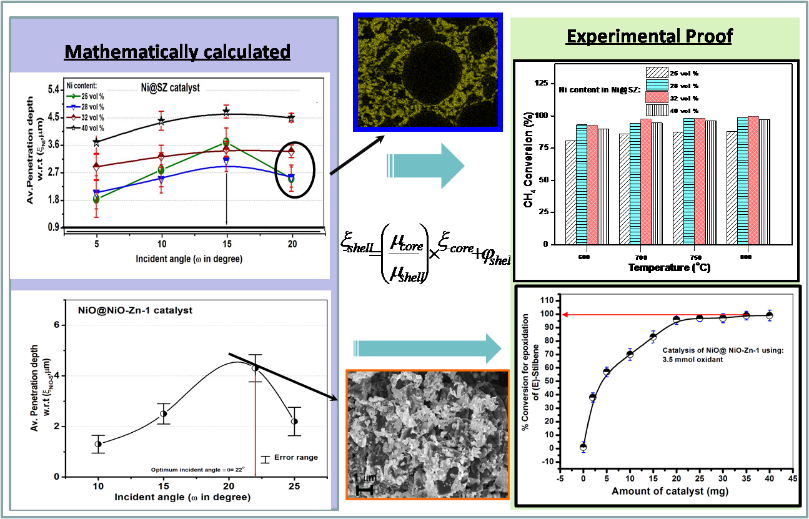
In summary, a mathematical model is developed for calculating X-ray penetration depth based on the theories of diffraction to quantitatively characterize the heterogeneous functional materials having core-shell morphology. Two functional materials viz. Ni@stabilized ZrO2 [Ni@SZ] and NiO@NiO-Zn are synthesized and penetration depth (ξNi/ ξNiO) is calculated using the proposed model as a function of composition. The composites, Ni@ZrO2 and NiO@NiO-Zn function as an effective catalyst for methane steam reformation and olefin epoxidation respectively.
The functionality of both Ni@SZ and NiO@NiO-Zn lies in their unique core-shell morphology which tends to interconnect both the phases and contributes towards catalyst functionality. The authors aim to optimize the Ni / NiO shell thickness using the mathematical model and correlate with the catalyst activity of methane steam reforming and olefin epoxidation. For Ni@SZ, the experimentally determined penetration depth values are validated by variation of Ni-content in the range of 25-40 vol %. The sequential increase of Ni-content in the composite from 25 to 40 vol % results in the reduction of penetration depth [~ 2.1 to 0.8 μm] relative to SZ-cores (ξYSZ-core) thereby restricting the SZ contribution.
The catalyst activity is significant within the Ni content range of 28-32 vol % with the least degradation after 100 hrs beyond which the catalyst activity degrades. This could be explained based on the functionality of such a core-shell catalyst wherein, the contribution of core (SZ) diminishes with an increase in shell thickness owing to the reduction in oxygen ion percolation by the continuum of the SZ phase. In a similar fashion, the surface coverage of nano NiO onto NiO-Zn for olefine epoxidation requires the involvement of a three-zone region involving primarily NiO, Zn, and pi electron cloud of the (E)-stilbene substrate. It has further been observed that catalytic properties of the aforesaid oxidation increase effectively with an increase in surface coverage by nano NiO compared to bare NiO-Zn.
Thus, catalytic properties of such heterogenous NiO@NiO-Zn have a direct correlation with the thickness of the surface coverage of the nano NiO and hence, the effectivity of the catalytic activity of such NiO@NiO-Zn matrix is found optimum (4.3 μm w.r.t. ξNiO) with the penetration depth derived from mathematical modelling. Hence, the mathematical modelling developed under this present investigation reveals its significance towards finding the penetration depth for core-shell type functional materials e.g. Ni@SZ and NiO@NiO-Zn for steam reforming and olefin epoxidation compared to disperse heterogeneous catalyst.
REF:
Sanchari Dasgupta, Madhumita Mukhopadhyay*, Debasis Das and Jayanta Mukhopadhyay*. “Evaluation of Functionality in Ni@stabilized ZrO2 and NiO@NiO-Zn through X-ray Diffraction Technique”. Material Chemistry and Physics. 254 (2020)123112 (1-15)
ACTREC Scientific Assistant Recruitment | Biotechnology | Life Sciences
-Shristi Sharma, Team bioXone ACTREC Scientific Assistant Recruitment – Biotechnology/ Life Sciences. MSc/MTech candidates with relevant experience are encouraged to attend an interview for a Scientific Assistant vacancy. ACTREC is hiring MSc candidates for Scientific Assistant vacancy. Interested candidates can check out all of the details below: ACTREC Vacancy Details No. Advt- PWT/24/2020 Position: Scientific […]